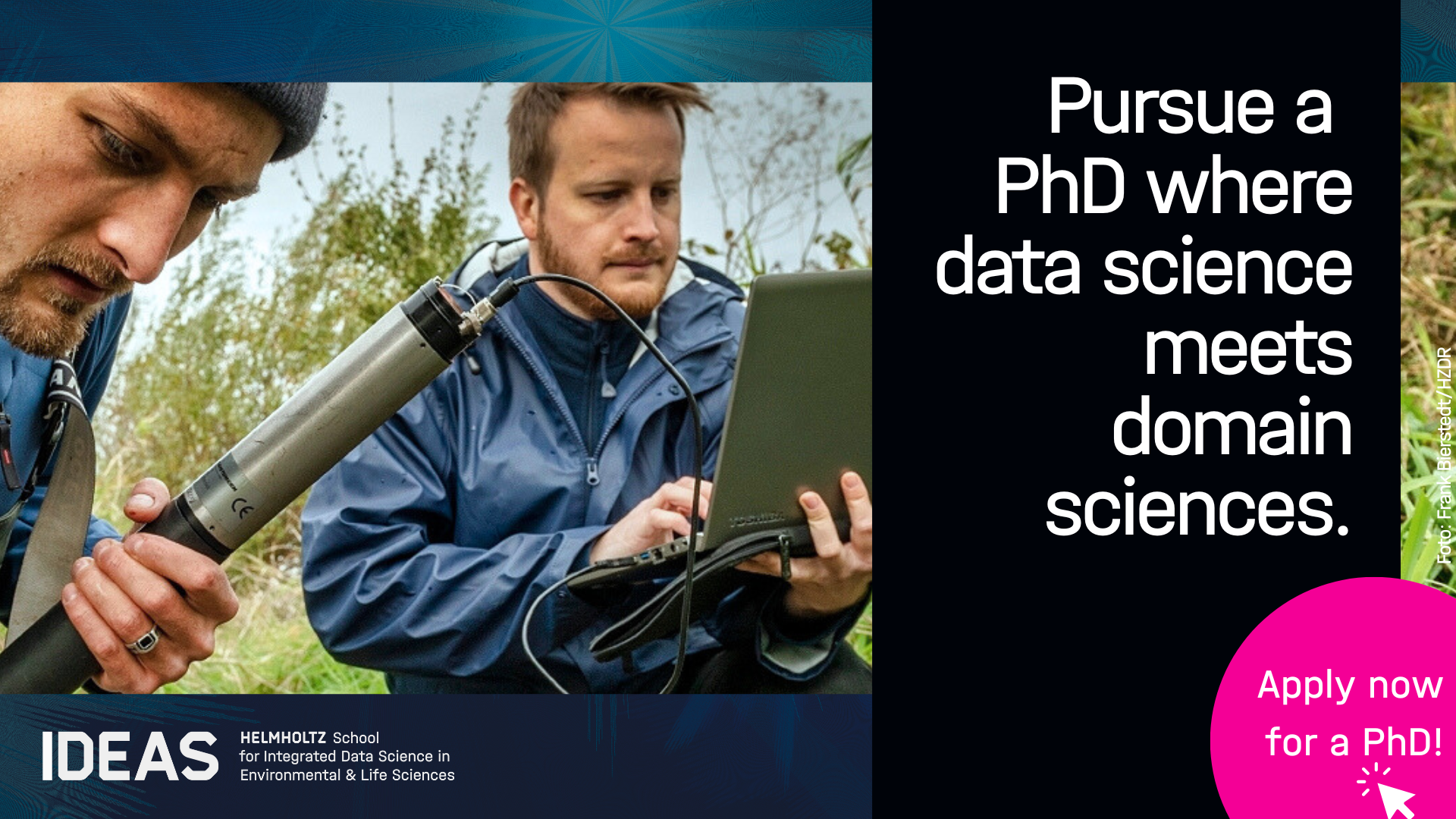
IDEAS recruits excellent PhD candidates at the interface of data science and environmental & life sciences. The recruitment process is project-based and designed to create a strong match between your profile, your preferred topic, and the supervision team.

Employment & funding
All IDEAS PhD positions are fully funded (100%) according to TVöD E13 for 3 years with the possibility of 1 year extension.
Key dates & timeline
Application deadline
22.02.2026, 23:59 CET
Candidate ranking
until 05.03.2026 (excellence-based ranking)
Interview week
11.03.2026 - 20.03.2026 (online interviews)
Expected start date
01.05.2026 or 01.06.2026
Dates may be adjusted slightly. Shortlisted candidates will be contacted by email.
More topics than positions
IDEAS typically offers a pool of project topics that is larger than the number of available positions, enabling better matching between candidates and projects.
In the first call, we advertise 6 funded PhD positions across 8 project topics. This means that even strong candidates may not receive an offer for their first-choice topic if it is already filled—however, the process is designed to support fair matching across multiple topics.
Candidates are evaluated and ranked based on scientific potential, achievements, and fit with the school and projects. More information about the process here
Innovation Track (propose your own idea)
In addition to the advertised projects, IDEAS offers an Innovation Track for exceptional, self-developed project ideas. A limited number of positions may be reserved for such proposals, which are considered alongside standard applications.
Your idea can be shaped freely, but it must fall within Life Sciences & Health or Environmental Sciences. Before applying, you must contact two PIs from the PI list and obtain their support: one PI from a Helmholtz Center and one PI from a university (Y-supervision principle).
Write your project proposal (max 2 pages) and add it to your cover letter. Then proceed with the application process as detailed below.
PhD projects
Climate Disasters
Understanding the drivers of climate disaster impacts
Supervising PIs:
Prof. Dr. Jakob Zscheischler (UFZ) & Prof. Dr. Miguel Mahecha (Leipzig University)
Additional PIs:
Jun.-Prof. Dr. Marlene Kretschmer (Leipzig University)
Disciplines: climate science, environmental sciences, data science
Motivation and research questions
Climate disasters regularly cause huge human and economic impacts. To improve current and future climate risk assessments, it is crucial to understand how factors such as climate hazard intensity, exposure, vulnerability, and environmental background conditions contribute to the observed impacts. Disentangling these contributions is a persistent challenge due to the limited availability of high-quality data on impacts and socio-economic conditions as well as the multitude of correlated and confounding drivers. Recently, a range of new datasets became available, which offer new opportunities to address this challenge. For instance, new datasets on when and where disasters occurred allow a more detailed assessment of hazard intensity or socio-economic conditions. Novel high-resolution socio-economic datasets and remote sensing-based datasets allow for an improved assessment of exposure and vulnerability. Yet key challenges remain. For instance, disaster impact data contains strong sampling biases. In commonly used national disaster databases, events (and therefore impacts) are only recorded once they exceed certain triggers. Furthermore, certain types of impacts are not well recorded in some countries, creating systematic data gaps that are difficult to identify or correct. Finally, the spatio-temporal nature of climate and environmental conditions violate the i.i.d. assumption of many machine-learning approaches, challenging the robustness and predictive capacity of trained models outside their training domain.
This project will develop robust data science approaches tailored to the data at hand to improve our understanding of the drivers of climate-related disaster impacts. In particular, interpretable machine learning approaches will be used to exploit available datasets to identify key drivers and driver interactions that contribute to disaster occurrence and impacts. Furthermore, robust cross-validation approaches tailored to the data structure will be applied to ensure trust in the findings.
Work environment
You will be a member in the Department of Compound Environmental Risks at UFZ, which conducts pioneering research into compound events, as well as the Institute for Earth System Science and Remote Sensing, which is world-leading in remote sensing research and the analysis of climate-related disasters. Both research groups feature a highly diverse set of researchers with different backgrounds, ranging from MSc students to group leaders. You will have offices in both research groups, with access to high-performance computing facilities with strong IT support. Your working contract will be with UFZ.
Degree: You will have the possibility to obtain a PhD degree from either Leipzig University or TU Dresden.
Keywords: climate disasters, hazards, vulnerability, non-i.i.d. data, domain shift
Prerequisites
To conduct this research, you should
- Hold a very good university degree (MSc or an equivalent) in datascience, computer science, mathematics, physics, environmental science or related disciplines.
- Have excellent programming skills
- Have a strong interest to work in a highly interdisciplinary environment.
- Posess very good written and spoken English skills for work in an international research environment.
Beyond Traditional Monitoring
Beyond Traditional Monitoring: Linking Citizen Observations, Regulatory Data, and Chemical Analytics for Freshwater Protection.
Supervising PIs:
Prof. Dr. Jörg Hackermüller (UFZ) & Prof. Dr. Gerik Scheuermann (Leipzig University)
Disciplines: Environmental chemistry, geo-spatial data science, natural language processing
Motivation and research questions
More than 300,000 chemical substances are commercially produced. Although exposure to chemical substances poses a significant threat to ecosystems and human health, and chemical pollution is one part of the triple planetary crisis, we have information on the distribution and hazards for only a small fraction of these substances. Substances never occur in isolation but in complex mixtures that can provoke combined effects, even when individual compounds occur below their individual effect thresholds.
We recently constructed a knowledge graph integrating concentrations of substances in aquatic environments with their associated hazards (https://doi.org/10.1016/j.envint.2025.109881). While this enabled assessment of whether few or many substances drive chemical mixture risk across locations, time, and species, data sparseness strongly hampered these analyses. This sparseness—resulting from opportunistic monitoring of different substances at different locations and time points—means we likely underestimated overall mixture risk, overlooked problematic drivers, and underestimated species-specificity.
Traditional approaches to addressing monitoring sparseness focus on statistical imputation and modeling. However, chemical pollution leaves observable traces beyond analytical measurements: fish kills reported in newspapers, citizens complaining about foul-smelling rivers on social media, and authorities issuing enforcement actions. Similarly, the regulatory landscape—discharge permits, water protection zones, land-use restrictions—creates spatial patterns of allowed and restricted emissions that directly influence pollution occurrence. These information sources have remained disconnected from chemical monitoring data, representing untapped potential.
We propose integrating three complementary data streams within SARDINE (Smart Regional Development Infrastructure), a geoinformation platform developed by one of the PIs that has proven capabilities in automatically extracting and georeferencing information from legal texts, official notices, and diverse spatial data. First, we will develop NLP methods to automatically detect pollution events in newspaper archives and social media, creating a spatiotemporally explicit database of observed impacts. Second, we will leverage SARDINE's strengths in text analysis to extract location-specific regulatory information, thereby building a comprehensive regulatory intelligence layer. Third, we will integrate these with chemical monitoring data from NORMAN EMPODAT and other databases.
This integration enables testing critical hypotheses: Can observable pollution events be explained by available chemical monitoring data, or do they reveal surveillance blind spots? Do pollution patterns correlate with regulatory coverage gaps? Can citizen observations and regulatory intelligence prioritize targeted monitoring? Since observed events and chemical monitoring data will rarely overlap in time and space, we will exploit the co-occurrence of chemicals arising from joint emission sources and model the distribution of substances along the river network to impute monitoring data. We will investigate whether information on chemical production, land-use patterns, and hydrological factors can support this imputation. Finally, we will evaluate whether this integrated assessment better explains biodiversity effects observed under the Water Framework Directive monitoring. This approach represents a paradigm shift from isolated measurements toward comprehensive environmental intelligence, combining analytical rigor with real-world observations and regulatory awareness.
Work Environment
You will work in inspiring environments at UFZ and the Department of Computer Science at Leipzig University. Your working contract will be with UFZ.
Degree: You will have the opportunity to obtain a PhD degree from the Faculty of Mathematics and Computer Science at Leipzig University.
Keywords: Chemical pollution monitoring, mixture risk assessment, geoinformation systems, text mining, regulatory intelligence
Prerequisites
To conduct this research, you should
- Hold a very good university degree (MSc or equivalent) in computer science, data science, or environmental sciences
- Candidates with a background in computer science or mathematics should have a strong interest in environmental sciences, in particular, environmental chemistry and toxicology.
- For candidates with a domain science background, a strong interest in computational methods, statistics, machine learning, and their formal foundations is required.
- Additionally, proficiency in at least one programming language commonly used in data science (Python, R, or similar) is required
- Familiarity with geospatial data and GIS concepts, natural language processing, environmental monitoring data, or pollutant transport modeling would be an advantage
- Have very good written and spoken English skills for work in an international research environment.
Decoding Protein Darkmatter
Decoding functions in the microbial dark matter: Towards protein classification and design through large language models
Supervising PIs
Dr. Ulisses Nunes da Rocha (UFZ) & Prof. Dr. Peter Stadler (Leipzig University)
Additional PIs:
Prof. Dr. Jana Schor (UFZ)
Disciplines: Data Science, Bioinformatics, Microbial Ecology
Motivation and research questions
This PhD project explores how modern machine-learning models can learn meaningful representations from biological sequences at very large scale. Using protein language models and extensive metagenomic datasets, the project investigates how evolutionary and ecological diversity affect generalization, robustness, and interpretability when models are applied to data that differ strongly from their training distributions. The work sits at the intersection of representation learning, large-scale data analysis, and computational biology, offering hands-on experience with foundation models, interdisciplinary research, and biologically relevant applications such as enzyme discovery and sustainability-related biotechnology.
The doctoral researcher will work with large-scale metagenomic datasets and state-of-the-art protein language models, supported by the UFZ’s EVE high-performance cluster and the ScaDS.AI data-science ecosystem. Their tasks will include to
- Develop and evaluate protein language models to study representation learning from biological sequence data.
- Analyze large-scale metagenomic datasets spanning diverse evolutionary lineages and ecological environments.
- Investigate model generalization, robustness, and uncertainty when applied to previously unseen protein families.
- Compare model architectures and training strategies across ecologically distinct datasets.
- Collaborate with experimental partners to validate computational predictions of protein function.
- Participate in interdisciplinary training, scientific workshops, and international research events within IDEAS.
Work Environment
The position is designed with a shared placement between the Helmholtz Centre for Environmental Research (UFZ) and Leipzig University (UL), with the student expected to spend approximately 60% of their time at UFZ and 40% at UL. This setup ensures close interaction with both supervisors and full integration into exceptionally international and interdisciplinary teams across bioinformatics, machine learning, microbial ecology, and evolutionary biology, representing more than 12 nationalities.
Your working contract will be with UFZ.
Degree: The PhD degree will be awarded by Leipzig University’s Faculty of Mathematics and Computer Science.
Keywords: Protein Language Models, Representation Learning, Explainable AI, Robustness under Distribution Shift, Hybrid Data–Theory Modeling, Microbial Functional Dark Matter
Prerequisites
- A strong MSc (or equivalent) in computer science, data science, bioinformatics, or a related computational or life-science field. (Exceptional candidates with a 5-year BSc and a strong publication record will also be considered.)
- Solid programming skills and experience with machine-learning methods for large-scale data analysis.
- Interest in deep learning, high-performance computing, genomics, or microbial ecology.
- Very good written and spoken English skills for work in an international research environment.
Estimating LLM Biodiversity
Biodiversity Estimation as a Lens into LLM Knowledge Content
Supervising PIs
Prof. Justin Calabrese (CASUS) & Prof. Simon Razniewski (TU DD)
Disciplines: AI foundations, statistical ecology
Motivation and research questions
Foundation models, in particular large language models (LLMs), have significantly advanced AI. A major contributor to their success is internalized knowledge, which in quantitative terms, is still poorly understood. LLMs memorize significant amounts of factual knowledge, however, there exists no reliable quantification of the extent of this knowledge, with orders of magnitude between known lower bounds (100 M facts) and naïve estimates of upper bounds (40 B facts) for frontier models like GPT-4. Exhaustively probing LLMs is unfeasible, for both computational and monetary reasons.
In this project, we explore alternative approaches inspired by the study of biodiversity in ecology. We hypothesize that internalized knowledge in LLMs (hereafter “knowledge diversity”) can be viewed analogously to biodiversity in ecological communities. Ecology has decades of experience in developing both theories to explain biodiversity, and statistical approaches to quantify it from limited samples. In particular, named entities in LLMs can, under some circumstances, be considered analogous to individuals within a species. Furthermore, LLM characteristics that correlate with increased knowledge diversity, including number of model parameters, size of the training dataset, and the total amount of compute time can also be mapped onto ecological concepts that correlate with increased biodiversity such as number of resource types, size of the species pool, and amount of successional time, respectively.
Quantifying biodiversity in ecological communities typically involves estimating the total number of species (i.e., species richness) and the abundance of each species from a limited set of samples. Communities can then be characterized, compared, and ranked in terms of their species richness and patterns of relative species abundance. A myriad of richness and abundance estimators exist in the ecological literature, with each making different assumptions and being tailored to different types of data. Limited samples of named entities memorized by an LLM can be readily obtained, which, together with the above-described analogies, suggests the possibility to leverage existing biodiversity estimation techniques to quantify knowledge diversity in LLMs. However, there currently exists no work that explores which biodiversity estimators are most suitable, which estimator assumptions are most plausible for LLMs, how LLMs should be sampled optimally to maximize compatibility with biodiversity estimators, or which existing biodiversity estimators are computationally efficient to handle the large samples that can be extracted from LLMs.
Computer science frequently supplies theory and techniques that accelerate discover in domain sciences like ecology. In this project, however, we look to a domain science to provide inspiration for quantifying the knowledge diversity of LLMs, which is a frontier problem in computer science. This approach could, for the first time, enable reliable estimates of the factual knowledge seen and memorized by LLMs, and therefore advance our understanding of the potentials and limitations of these models. For ecology, it could provide a stress test for estimation techniques on very large datasets, lead to improvements in the computational algorithms underpinning biodiversity estimators, and emphasize the wider relevance of statistical ecology beyond the core conservation science domain. This work therefore has the potential to significantly advance both computer science and ecology.
Work environment
You will have access to the AI expertise of the ScaDS.AI center, covering a broad range of topics of machine learning fundamentals to LLMs and neurosymbolic AI. You will have access to a top-100 worldwide supercomputer at ScaDS.AI, and work closely with the development team of GPTKB. You will also have access to the highly interdisciplinary environment of CASUS/HZDR, with expertise spanning quantitative ecology, computational physics, computer science, and a strong emphasis on data science, machine learning, and AI. Your working contract will be with HZDR.
Degree: You have the possibility to obtain a PhD degree at TU Dresden either from the Faculty of Computer Science or from the Faculty of Environmental Sciences.
Keywords: Foundation models, Large language models (LLMs), biodiversity estimation
Prerequisites
To conduct this research, you should
- Hold an advanced university degree (MSc or an equivalent) in computer science, mathematics, environmental informatics, statistical ecology, physics, statistics / machine learning, or related disciplines.
- Have strong expertise with data science methods and working with large datasets, and
- Have experience with LLMs is also highly desirable though not strictly required.
- Possess very good written and spoken English skills for work in an international research environment.
Agentic Cancer Care
An agentic AI approach to reduce overdiagnosis, overtreatment and unnecessary disease monitoring in prostate cancer
Supervising PIs
Dr. Michael Bussmann (HZDR) & Prof. Dr. Gerik Scheuermann & Prof. Dr. DMSc. Michael Borre (Aarhus University Hospital, Denmark)
Additional PIs: Dr. Johannes Thestrup Aksglæde (Aarhus University Hospital, Denmark)
Disciplines: Oncology, Urology, Multimodal AI + HPC in oncology
Motivation and research questions
Overdiagnosis, overtreatment, and unnecessary disease monitoring is a major challenge in prostate cancer and can be avoided for 100,000s of men in Europe alone, while the disease incidence will rise dramatically towards 2040. Many men on Active Surveillance (AS) undergo unnecessary repeated imaging, biopsies, and clinical visits despite indolent disease. When treated surgically, patients experience unnecessary long-term subversive side effects from extended pelvic lymph node dissection based on simple normal glands developed on small cohorts with little external validation. Patients in medical treatment undergo expensive, intensive imaging without any clear benefit or data-driven guidelines. While registries can provide some insight, rich information is severely lacking on disease behavior. This information is embedded in unstructured electronic health record (EHR) text, radiological reports, and raw scans (prostate MRI, PSMA PET/CT, CT-Bone), and longitudinal treatment trajectories, but this is not exploited systematically in large scale for indecision making.
This project proposes to utilize and develop a local, large, multimodal AI agent and foundation model framework to read both unstructured EHR text and raw imaging data (prostate MRI and PSMA PET/CT) and construct a unified, computable, longitudinal disease trajectory both retrospectively and real time for each patient evaluated for suspected or confirmed prostate cancer in all hospitals in Denmark. This trajectory will be harmonized to EAU UroEvidenceHUB (UEH)-aligned, structured datasets hosted at Helmholtz enabling evaluation between Danish and European cohorts without sharing patient level data, thus providing solid evidence to guide treatment.
We will then use the model derived variables from these trajectories to address three clinically distinct but related overtreatment harms. Our core research questions are:
- Can locally supercomputer-deployed multimodal agents and foundation models that ingest unstructured electronic health record (EHR) text and raw imaging data (including prostate MRI and PSMA PET/CT) reliably construct a unified, computable, longitudinal patient trajectory for men undergoing evaluation for suspected prostate cancer; with data quality and completeness comparable to expert manual curation, while ensuring harmonization with EAU-aligned structured datasets hosted at Helmholtz?
- Can variables derived from these trajectories:
- identify men on Active Surveillance who can safely avoid or discontinue further follow-up without an increased risk of clinically significant progression, and
- drive development of an intelligent Briganti-like tool that helps avoid severe long-term side effects of surgery and radiotherapy by accurately predicting adverse pathological features and lymph-node involvement, based on integrated EHR data, prostate MRI, and PSMA PET/CT, and
- predict which men with hormone-sensitive prostate cancer (HSPC) receive systematic therapy (ADT ± ARPI ± chemotherapy) are unlikely to benefit from routine imaging (CT, bone scan, PSMA PET/CT), enabling personalized imaging de-escalation and development of adaptive, AI-based imaging strategies during systematic treatment, and
- be trained, recalibrated, and externally validated in Helmholtz supercomputing infrastructures, where Helmholtz contributes EAU-aligned structured datasets
Expected results include:
Once implemented, the innovation will disrupt cancer treatment monitoring and will potentially be scalable across all other cancers and will guide both treatment and data-driven decision-making at the European level through UEH.
Work environment
The doctoral researcher will mainly work at HZDR with frequent visits to Aarhus and will take active part in all IDEAS activities. The doctoral researcher will work across two internationally leading environments: Aarhus University Hospital & DTU. Your working contract will be with HZDR.
Degree: The PhD degree will wither be awarded from
Keywords: Prostate cancer treatment monitoring, LLM agents, foundation models, continuous model monitoring
Prerequisites
The envisioned candidate has an excellent master's degree (MSc or equivalent five-year university education) in Computer Science and Data Science, with an academic record among the very best in their year and a strong interest in medical applications.
The candidate has
- Strong communication skills and enjoys working in a cross-disciplinary international team,
- Very strong analytical skills and solid programming experience,
- An entrepreneurial, proactive mindset and curiosity for turning ideas into practical solutions,
- Willingness to work with real clinical and imaging data under strict privacy rules.
- Very good written and spoken English skills for work in an international research environment.
The prospective candidate has no clinical background which will be covered by Aarhus University.
Inequalities Climate Discourse
Inequalities in political attention to climate change through computational text analysis
Supervising PIs
Dr. Mariana Madruga de Brito (UFZ) & Prof. Manuel Burghardt (Leipzig University)
Additional PIs: Dr. Taís Maria Nunes Carvalho (UFZ) & Dr. Andreas Niekler (Leipzig University)
Disciplines: Environmental Sociology, Computer Science, Computational Social Sciences
Motivation and research question
Political responses to climate change are shaped by inequalities in how climate disasters affecting different societal groups receive attention. While disasters in rich or geopolitically central regions attract political attention, equally severe disasters in poorer or marginalized countries often remain ignored. In this context, the political visibility (or lack thereof) influences diplomatic agendas, humanitarian priorities, and the allocation of aid and adaptation finance.
Evidence of these attention dynamics is embedded in large volumes of political text, including UN General Debate speeches (1970–2024) and national parliamentary debates (Germany, UK, USA). Yet these corpora are far too large to analyze manually. Computational and data-science methods are therefore essential for systematically investigating how climate change and its related disasters enter political discourse across different countries. Advanced text-mining techniques enable the identification of which hazards and disasters are mentioned, how they are framed, and how attention shifts over time.
To analyze how climate change and which related disasters are discussed, this project will combine text-embedding-based clustering, classification models, and topic modeling. Specifically, we will (i) identify key frames and narratives discussed in political texts (e.g. humanitarian, security, development, responsibility), (ii) measure how different countries and societal groups are considered or not in the political discourse, and (iii) quantify topic attention over time. Furthermore, by linking these patterns in political discourse with real disaster impact data (EM-DAT, DesInventar) and development-finance datasets (OECD DAC, World Bank, national donor reports), we will assess how political attention matches disaster severity and examine the role of political debates in shaping aid allocation.
The project advances Environmental Sociology research by generating the first international, long-term analysis of political attention to climate change and related disasters. It will reveal which hazards and regions are consistently underrepresented in diplomatic and parliamentary debates. The project also contributes to Computational Social Science by developing innovative pipelines to address challenges in dealing with unstructured political texts.
Work environment
The candidate will be situated at the Computational Social Sciences for Extreme Events group at UFZ, led by Dr. de Brito, and the Computational Humanities group at Leipzig University, led by Prof. Burghardt. The PhD candidate will have workspaces in both labs, with most on-site presence at the UFZ. Your working contract will be with UFZ.
The groups are characterized by an open culture, with team members from diverse countries and disciplines. To support professional development, the candidate will be encouraged to participate in international conferences and summer schools. Flexible remote work arrangements will be available to support a better work-life balance.
Degree: The candidate will be enrolled at Leipzig University and will pursue a degree in Computer Science or Digital Humanities.
Keywords: Text Mining, Large Language Models, Machine Learning, Discourse Analysis, Climate Policy
Prerequisites
- Master’s degree in Computational Social Science, Data Sciences, Computer Sciences, Digital Humanities, Social, Political, Environmental, Geography, or Earth-System Sciences or related disciplines with a focus on data analytics.
- Strong interest in investigating social inequalities, climate disasters, and the political dimensions of climate change.
- Proficiency in programming, preferably Python or R, for data processing and analysis.
- Motivation to work in a multidisciplinary, international research team.
- Excellent knowledge of written and spoken English.
Preferred further qualifications
- Experience with computational text analysis, including NLP, Large Language Models, or cluster computing, is an advantage.
- Familiarity with data management and integration of large, heterogeneous datasets.
- Knowledge of statistical modeling, topic modeling, or machine-learning approaches.
- Interest in linking social-science and environmental datasets for policy-relevant research.
- Experience in interpreting and visualizing complex data for scientific and policy audiences.
EXACT
Explainable Graph-based AI for Credible Toxicity Prediction
Supervising PIs
Prof. Dr. Jana Schor (UFZ) & Prof. Dr. Peter F. Stadler (Leipzig University)
Additional PIs: Jun.-Prof. Dr. Julia Westermayr (Leipzig University)
Disciplines: Computer Science; Computational Toxicology; Graph Theory; Environmental Sciences.
Project focus
Chemical pollution is a key driver of the triple planetary crisis, yet the use of AI-based toxicity prediction in regulatory and environmental contexts is still limited by a lack of transparency and trust. This PhD project aims to develop explainable and uncertainty-aware graph-based AI models for chemical toxicity prediction. By combining graph theory, machine learning, and computational toxicology, the project seeks to make AI predictions interpretable and credible for real-world environmental decision-making.
Central research question:
How can graph-based AI models for chemical toxicity be designed, trained, and explained such that predictions from chemical structure become both accurate and credibly interpretable for use in computational and regulatory toxicology?
Key tasks and responsibilities
- Curate and harmonize public chemical toxicity datasets (e.g. Tox21, ECOTOX, NORMAN SusDat)
- Design and train graph neural network models for toxicity prediction
- Develop methods for explainability and uncertainty quantification in graph-based models
- Link model explanations to chemically meaningful substructures and toxicological concepts
- Benchmark models and explanations using real-world toxicological case studies
- Publish results in interdisciplinary journals and present them at international conferences
Work environment
The doctoral researcher will be jointly based at the Helmholtz Centre for Environmental Research (UFZ) in Leipzig and at Leipzig University. Your working contract will be with UFZ.
The project is embedded in an interdisciplinary environment combining bio-data science, graph theory, and computational toxicology. You will have access to high-performance computing infrastructure and benefit from the structured training and networking activities of the Helmholtz IDEAS graduate school.
Degree: You will have the possibility to obtain a PhD degree in Computer Science from the Faculty of Mathematics and Computer Science at Leipzig University, where the PIs hold faculty positions.
Keywords: Graph neural networks, Explainable AI, Computational Toxicology, Uncertainty quantification
Prerequisites
- Very good MSc degree (or equivalent) in Computer Science, Bioinformatics, Computational Chemistry, Mathematics, or a related discipline
- Strong interest in data science and environmental or life sciences
- Programming experience, preferably in Python
- Basic knowledge of machine learning; experience with graph-based methods or cheminformatics is an advantage
TrustSeg
Trustworthy AI for Clinical Image Segmentation
Supervising PIs
Prof. Dr. Steffen Löck (HZDR) & Prof. Dr. Stefanie Speidel (TU Dresden)
Disciplines: Computer vision, deep learning, translational cancer research (radiotherapy, surgery), medical physics, human-AI interaction, trustworthy and explainable AI
Motivation and research question
Artificial intelligence is increasingly used to support clinical decisions in radiotherapy and surgery, yet current segmentation models can fail silently in unfamiliar or safety-critical situations. This PhD project addresses this challenge by developing uncertainty-aware and trustworthy segmentation methods that make model confidence explicit and help clinicians make safer, better-informed decisions.
The central research question is:
How can we design and integrate uncertainty-aware segmentation models that provide reliable confidence estimates and improve safety and decision-making in radiotherapy planning and surgical workflows?
Key Tasks and Responsibilities
- Develop deep learning–based segmentation models with integrated uncertainty quantification
- Design and evaluate methods to visualize and communicate uncertainty in clinical workflows
- Apply and validate the developed approaches in radiotherapy planning and surgical imaging/video scenarios
- Collaborate closely with clinicians, medical physicists, and computer scientists in an interdisciplinary environment
- Publish research results in peer-reviewed journals and at international conferences
Work environment
The position is jointly supervised and based on the medical campus of TU Dresden, with workplaces at:
- OncoRay – National Center for Radiation Research in Oncology, and
- National Center for Tumor Diseases (NCT) Dresden
Both sites are located next to each other and offer access to real clinical data, imaging systems, and state-of-the-art research facilities.
Your working contract will be with HZDR.
Degree: You will have the possibility to obtain a PhD degree from either the medical or the computer science faculty of TU Dresden.
Keywords: Segmentation, uncertainty quantification, spatiotemporal modelling, radiotherapy planning, surgical navigation, clinical decision support, uncertainty visualization, trust and usability
Prerequisites
- Master’s degree (or equivalent) in computer science, electrical engineering, applied mathematics, medical physics, or a related field
- Very good programming skills (e.g., Python)
- Background or strong interest in one or more of the following areas:
- Machine learning / deep learning
- Computer vision
- Robotics or medical image analysis
- Ability to work independently and collaboratively in an interdisciplinary research team
- Strong motivation to work on clinically relevant, safety-critical AI applications
Innovation Track
You have an own project idea fitting within IDEAS' scope?
If you have an own project idea for a PhD project at the intersection of Domain and Data Science, that falls within Life Sciences & Health or Environmental Sciences, you write a short project proposal and contact 2 PIs from our PI list (People --> Principal Investigators) who could support you based on our Y-supervision principle and obtain their support.
Then you submit your application and get evaluated together with all other applicants based on your scientific potential, achievements, and fit with the school.
Prerequisites
You should have
- A strong MSc (or equivalent) in computer science, data science, or a field related to your chosen project.
- Solid programming skills and experience with machine-learning methods.
- Very good written and spoken English skills for work in an international research environment.
How the application process works
-
Select and rank projects you’re interested in
Review the PhD projects listed above and select all projects you would seriously consider. Then rank your selected projects (1 = top choice). You must choose at least one project (we recommend three or more)—or choose the Innovation Track to submit your own project idea (see details above). -
Prepare your documents
-
Cover letter explaining your motivation to pursue a PhD within IDEAS, your research interests, and relevant experience and, in case you chose to submit your own project idea, add this to the cover letter
-
Master’s certificate (digital copy)
-
Transcript of records
-
Two reference letters (please upload the actual letters; contact details alone are not sufficient)
3. Create one PDF and submit
Combine the documents above in this order into one single PDF and submit it via the UFZ recruiting page.
Application package builder (recommended)
Use the application package builder to compile your materials. You can upload your PDFs here, and rank your preferred PhD projects directly on this page (the ranking is done locally in your browser—no files are required for that step). The tool generates one merged PDF you can download. Then proceed to the recruiting page to enter your personal details and upload your application package.
For more information contact our coordinators

Dr. Sandra Hille
Coordinator IDEAS (UFZ)
Contact

Anne Pidt
Coordinator IDEAS (HZDR)
Contact